


Loading the content... Loading depends on your connection speed!

The latest news and views from the Bennetts team

Featuring the latest news on the coffee industry and business insight from senior members of the Bennetts team.

Bennetts > Blog

BENNETTS ORIGIN REPORT
Thursday 16 April 2026 by Marketing - HABApril 2026Newsorigin

Find out the latest news from Brazil!

ORIGIN REPORT - BRAZIL


Welcome to our April origin report!

Last month our Account Manager, Diego, paid a trip to his home country Brazil, after nearly three years living in Australia. Starting his journey in Santos where he visited family, he then drove 849km to the coffee regions of Southern Minas Gerais, one of Brazil's most critical Arabica producing areas, responsible for a significant share of the country's total output and quality.

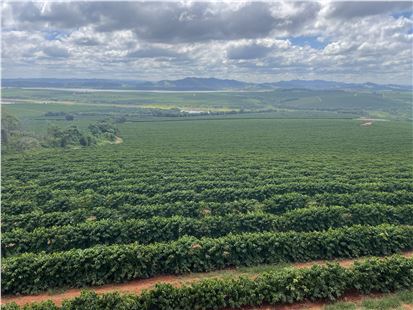
What he found was highly encouraging: healthy trees, strong cherry development, and producers investing meaningfully in their operations and improved logistics. He returned to Melbourne with a confident and optimistic outlook for the 2026 Brazilian crop.


Diego admiring the bountiful trees this season


Crop conditions
 

Currently cherries are in the maturating stage, with harvest expected to start next month in May. Consistent rainfalls over the past few months have fostered healthy, vigorous plants with low incidence of disease and stress. This also supports the formation of fruit setting and bean development. The result is well structured and dense cherries with excellent visual quality.

Furthermore, off-season management has been effective in strengthening tree health. Evidence is, there has been no widespread pest or disease observed across the farms this season. This builds a solid foundation not only for this crop but also for future harvests. 

The fruit load this season is notably high and development is uniform across well managed farms. However, the heavy cherry load in some areas may lead to uneven ripening, requiring careful attention during harvesting to maintain consistent quality. This is already on producers' radar, and selective picking practices will be important in those lots.
 
In short, the Brazil crop outlook for 2026 is positive in terms of both volume and quality.


Challenges for the upcoming harvest

Having said that, a key challenge producers face this season is the lack of labour availability. The primary harvesting method in Southern Minas Gerais is mechanical harvesting, while hand-picking is mainly for specialty lots and smallholders. As younger generations move away from the coffee fields, a number of producers are facing shortages in manual harvesting capacity. These shortages may cause localised delays and affect quality in certain lots, influencing the pace at which coffee reaches the market. In response, producers are increasingly investing in machinery.

Climate Risks

Weather will remain the most significant risk driver in the months ahead. The June to August window is critical, with potential for disruptive rainfall and, in more extreme scenarios, frost events. Either could damage cherries and trees, delay drying, increase defects and moisture levels, impacting both final quality and crop volume. Close monitoring and timely adaptation will be essential.

Sustainability Advancements

Brazilian producers continue to make consistent progress in sustainable practices. Diego observed increased investment in environmental preservation, water resource management, and rainwater harvesting systems. These initiatives provide adaptations for climate risks, add tangible value to the product, and align with growing global demand for sustainable coffee production

Logistics have also improved remarkably. Historically, poor road infrastructure and frequent potholes led to accidents and truck breakdowns along key supply routes. Upgraded infrastructure and new toll-managed sections have made the transportation of coffee between farms and warehouses considerably smoother. The result is a more fluid, reliable supply chain from farm gate to export.


Ipanema Estate with water management and irrigation systems


Conclusion
 
The picture emerging from Southern Minas Gerais is one of strong potential. Favourable weather, healthy trees, advanced cherry development, and proactive farm management all point toward a promising Brazil crop, one that could approach record production levels for 2026, while also laying a solid foundation for 2027. Provided weather conditions remain stable through the harvest window, Brazil is expected to offer attractive commercial opportunities throughout the cycle, both in terms of volume and price competitiveness.

Happy Roasting,
The Bennetts Team  
Took 0 milliseconds
loading...